Katia Grim in Dungeon Crawler Carl: The Doppelganger Professor Explained
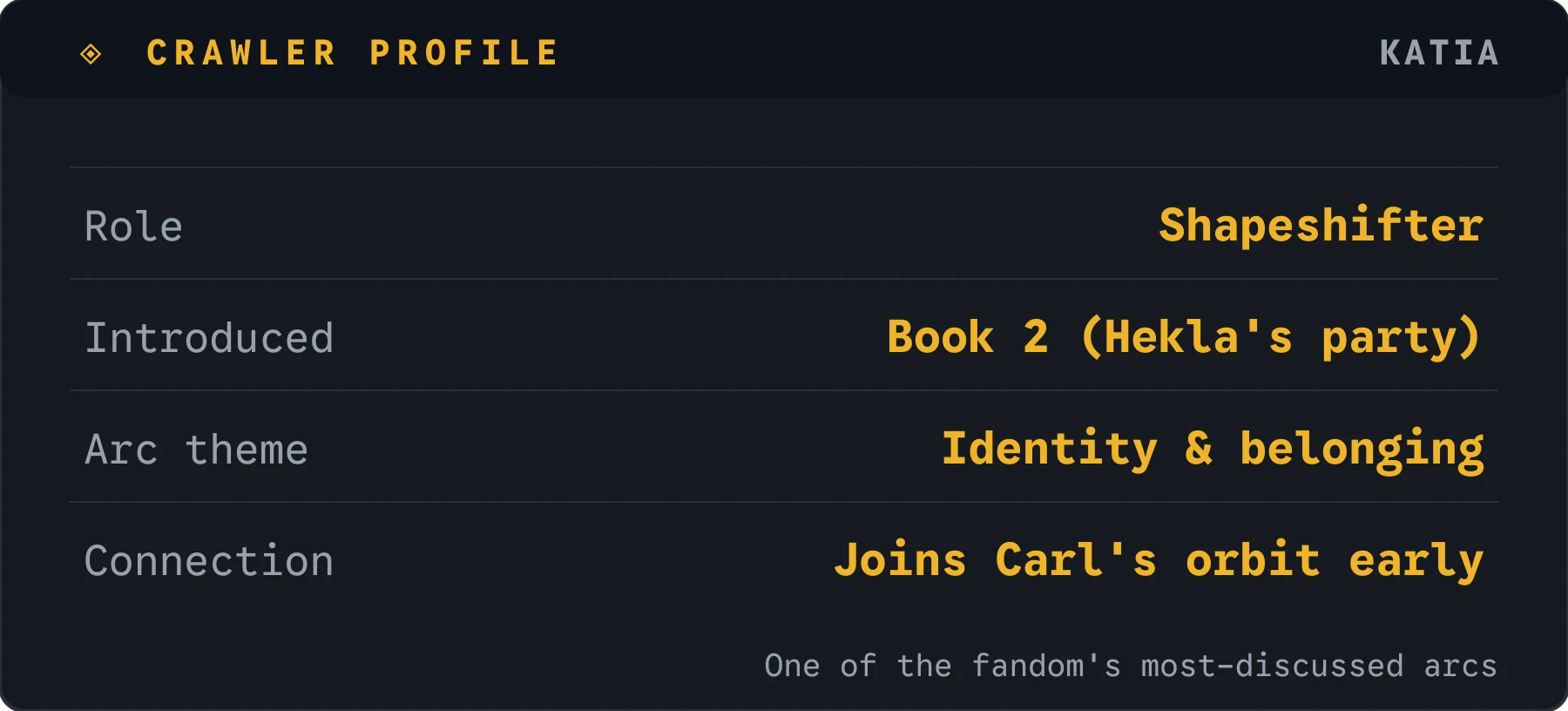
Katia Grim is Dungeon Crawler Carl’s most profound transformation story — and in a series where people literally transform, that is saying something. An Icelandic university professor who enters the dungeon with a scarred, burned face, she ends up a shapeshifting Doppelganger whose body, loyalty, and identity become central to the series’ endgame politics. She is also the connective tissue between the series’ two great factions: sent to Carl by Hekla, kept by trust.
This guide follows her book by book, with spoiler boundaries marked — because Katia’s arc is one you should experience in order.
Spoiler structure: her introduction (book two) is safe below. Everything from “The Floor 4 Break” assumes you have finished book four. Her Royal Court material assumes book five and beyond.
Who Is Katia Grim?
Katia is an Icelandic professor — the series’ most educated crawler in a cast of coast guardsmen and show cats — who enters Dungeon Crawler World: Earth with her face scarred and burned from the collapse. That injury is not cosmetic backstory: the dungeon’s economy runs on image, sponsorships, and screen presence, and Katia begins her crawl at a disadvantage the system never lets anyone forget.
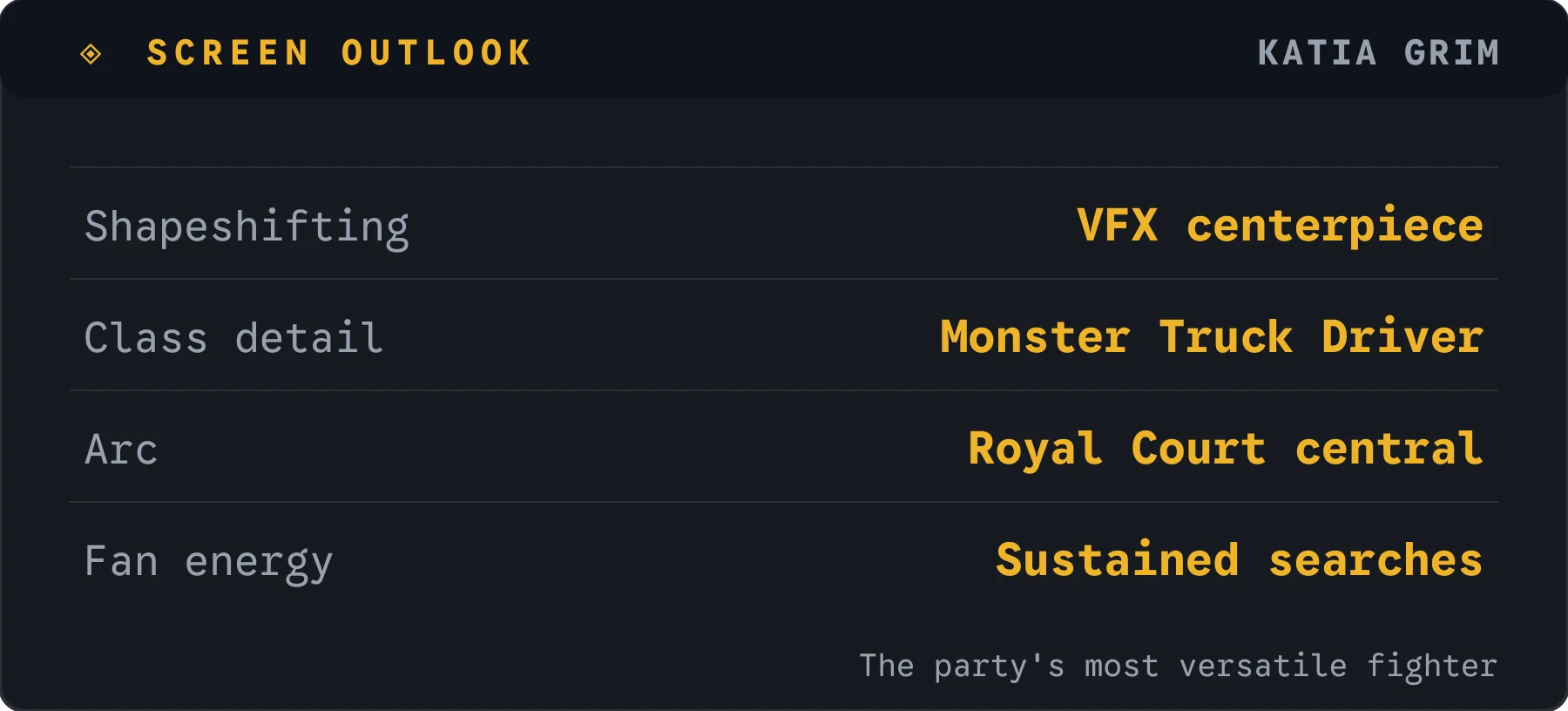
Her class is a fan-favorite absurdity: Monster Truck Driver, complete with HAZMAT endorsement — a choice that says everything about the dungeon’s randomized cruelty and her determination to drive something, anything, forward anyway.
The Handoff: Hekla Sends Katia to Carl
Katia first appears in book two, chapter 68, near the end of Floor 3. Originally a member of Hekla’s Brynhild’s Daughters, she was separated from the faction on the train floor. Hekla — who knows exactly what the deeper floors demand — asks Carl to temporarily partner with her.
Carl agrees, and the arrangement outlives its temporary framing. Katia’s shapeshifting abilities make her a versatile combatant and infiltrator almost immediately, but the real value is quieter: she becomes one of the first people Carl’s faction can actually trust across faction lines.
The Doppelganger Transformation
Katia’s species evolution is the series’ most literal identity metaphor. From human to Doppelganger, she gains extraordinary shapeshifting — the ability to rebuild herself at will. The books track what that does to a person who started the crawl unable to look at her own reflection:
- Book two: a timid, rabbit-like newcomer; skittish, uncertain, visibly relieved to be someone’s responsibility.
- Book three: cosmetic surgery, a purple mohawk, an edgy silhouette — the dungeon’s toll visible in a haunted stare that no new face fixes.
- Book four: a tall, athletic shapeshifter whose monstrous forms become vital to party tactics. The body is finally hers because she can make it anything.
Major spoilers below — the Floor 4 break and the Royal Court assume book five and later.
The Floor 4 Break: Hekla’s Death
Katia’s arc detonates on Floor 4. Book four reveals that Hekla — the leader who sent her away, the mentor she owed her survival — had been orchestrating secret attacks against her. The confrontation that follows ends with Hekla dead, killed accidentally by Katia in a fight Hekla’s own schemes created.
The fandom still argues about that scene, and the books want it that way: the leaderboard’s paranoia machine produced a death where guilt has no clean address. Katia walks away from Floor 4 free of Hekla and burdened by her, and every choice she makes afterward is colored by it.
Team Katia and the Royal Court
Katia’s growth stops being solitary in the later books. She builds Team Katia — a crawler group including Bautista, Britney, Firas, Louis, and Florin — proving the healer’s lesson from the other direction: Imani builds a guild around care; Katia builds a team around loyalty earned through shared damage.
Her shapeshifting then becomes politically central: her loyalty and her body both become assets of the Royal Court, the series’ most consequential late-game institution. Without spoiling the specifics, the professor who once couldn’t face a mirror ends up deciding what face the endgame wears.
Katia’s Book-by-Book Evolution
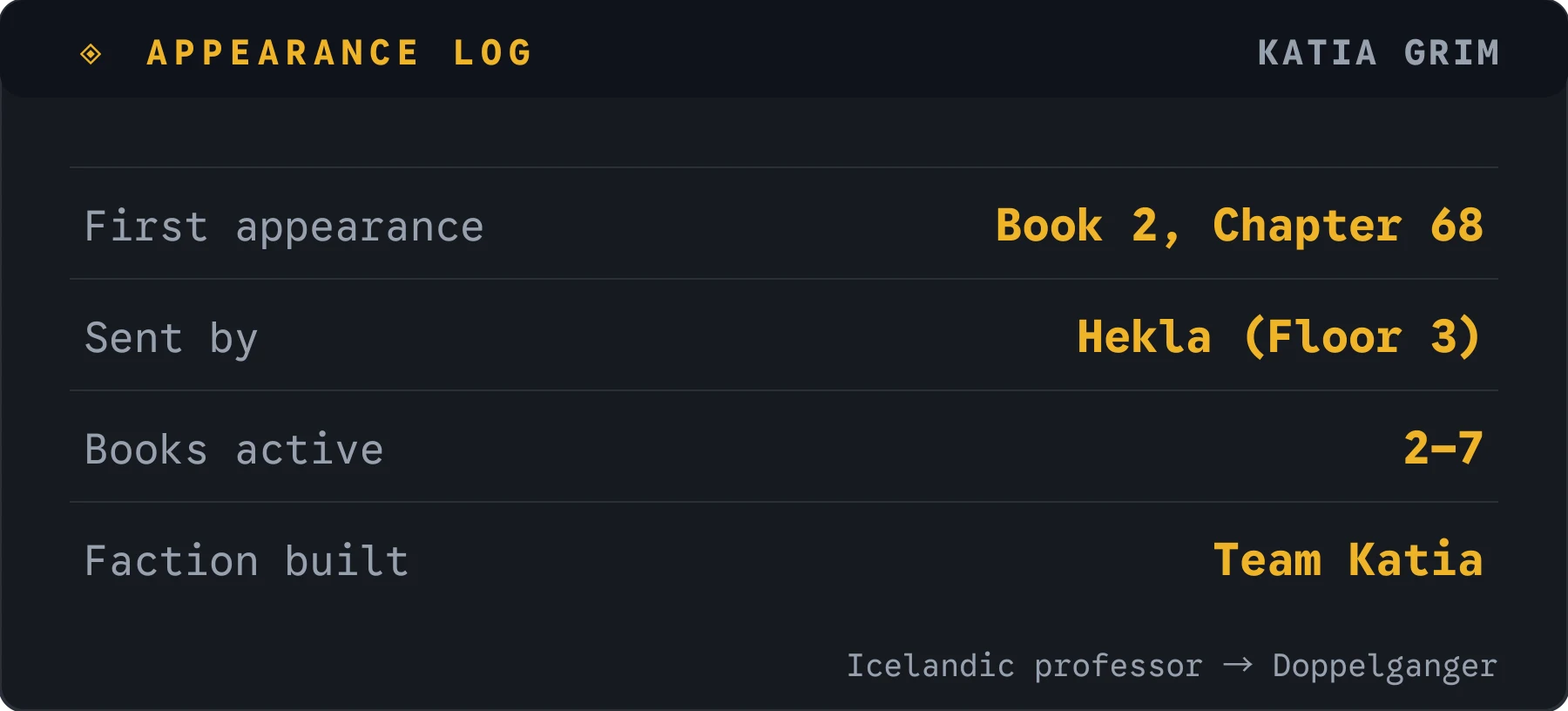
| Book | Evolution |
|---|---|
| 2 | Rabbit-like newcomer; joins Carl’s party (Ch. 68) |
| 3 | Purple mohawk era; survival hardens her |
| 4 | Athletic Doppelganger; Hekla confrontation |
| 5–7 | Team Katia; Royal Court centrality |
Katia in the Peacock TV Show
Katia is the adaptation’s shapeshifting VFX showcase — every season she appears, the effects budget gets a starring role. No casting exists yet (casting news tracker), and her Icelandic professor backstory makes her a dream casting conversation once the show reaches her floors. The TV show hub tracks everything official.
Frequently Asked Questions
Is Katia a hero or an antagonist?
A hero with blood on her hands — the series’ specialty. The Hekla confrontation is accidental but not innocent, and Katia’s later arc is partly about what you build after surviving something you caused.
Which book is Katia’s biggest role?
Her introduction lands in book two, but books four and five are where her transformation and its consequences take over the story. Read in order — our reading order guide keeps the spoilers where they belong.
Why did Hekla send Katia to Carl?
Surface reason: Katia needed protection after being separated from the Daughters. Real reason: Hekla’s own politics, which book four exposes. The handoff is kindness and chess move at once.
Where can I verify Katia’s details?
Community references track her meticulously: dungeon-crawler-carl.wiki, the Fandom wiki’s Team Katia page, and fan compendiums. For the full cast context, see our characters guide — and for the cat who started it all, the Princess Donut profile.
The Doppelganger as Narrative Technology
Katia’s species change is the series’ boldest use of its own mechanics. LitRPG transformations usually escalate power; Katia’s escalates identity. A shapeshifter who entered the dungeon hating her reflection gains the ability to be anyone — and the books treat that as a problem before a power, because the dungeon’s economy already told her what faces are worth.
Her Royal Court era completes the argument. The endgame politics require exactly her skills — infiltration, adaptation, trustworthiness under shifting appearances — and the series stages its most consequential late-game trust around a character whose entire premise is that appearance is negotiable. That is craft: the theme, the mechanic, and the plot converging on one character.
Team Katia deserves mention too: Bautista, Britney, Firas, Louis, Florin — the faction she built proves her arc’s thesis that loyalty can be manufactured from shared damage. References for deeper dives: dungeon-crawler-carl.wiki, the Fandom wiki, and our characters guide.
Reader Notes for Katia
Spoiler hygiene: Katia’s arc is the series’ most spoiler-dense — her transformation, the Floor 4 confrontation, and the Royal Court material each land harder unspoiled. This page’s warnings are calibrated; respect the boundaries.
Trend note: sustained search interest for Katia reflects her Royal Court era — readers reaching books five through seven look her up in bulk, and Team Katia’s roster drives recurring queries.
Cross-reference: the Hekla profile covers the handoff and its fallout; the characters guide maps the full roster; and Goodreads carries the reader-side reception of her arc.